The word “coon” has been used as an epithet to attack African Americans since at least the mid 1800’s. It was featured in blackface performances popularized during Andrew Jackson’s administration. Jim Crow-era newspaper clippings are littered with the slur. Recently, the word was scrawled across the sidewalks outside a Kentucky university housing black students.
There is debate on the origin of the epithet. Some linguists believe it was shortened from the word “barracoon” which came from the Portuguese word, “barraca.” Barraca referred to cages used in the West African slave trade to hold and transport kidnapped people.
Used as a slur, there is no doubt “coon” is a word of violence.
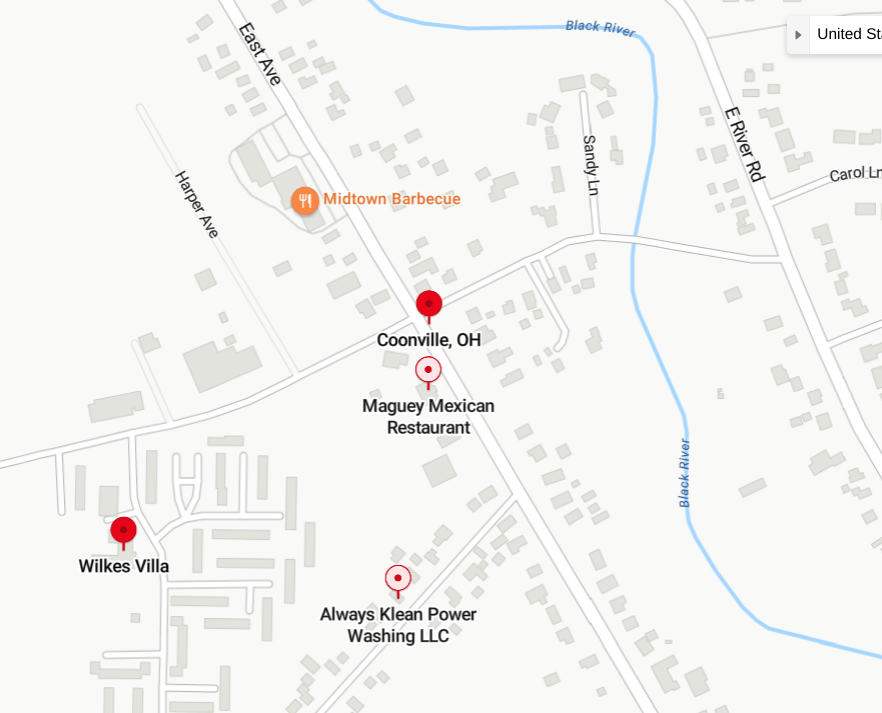
It should come as no surprise, then, that many Lorain County residents have been horrified to see the name “Coonville” listed on Bing Maps in an area just south of Elyria.
The controversy of area maps listing “Coonville” at the intersection of Grafton and Fuller Roads is nothing new. Locals recall seeing posts on message boards in the early days of the internet demanding area maps be scrubbed of the epithet. The United States Geologic Survey, which has the duty of labeling official maps, was lobbied to remove the name. Three years ago a local resident started a petition on Change.org to ask Elyria’s Mayor Frank Whitfield to do the same. This past week, Whitfield told City Council he is working with Google and Bing to have the name removed from their maps.
It appears most Lorain County residents would agree that it’s time to say, “Good riddance to Coonville.” So why is the name still appearing on our maps?
Sometime around 1854, possibly as early as 1850, a New Yorker named Charles Coon settled in northern Carlisle Township just south of Elyria’s city limits. He built a dam and a sawmill, his first of many successful business ventures.
The area prospered. Ice houses were built with blocks harvested from the Black River near the location of today’s Fuller Road bridge. That business was called Coonville Ice. It was followed by Coonville School and a factory named Coonville Company.
Charles, it seems, had a penchant for self-promotion when it came to marketing his name. And it worked.
The area around what is now East Ave/Grafton Road and Fuller Road was colloquially known as “Coonville” as early as 1862. A newspaper article from the time reported the tragic drownings of “three boys from Coonville.” In 1864 a woman wrote an open letter to the paper thanking “the people of Elyria and Coonville” who assisted her and her ailing father as they traveled through the area. An article from 1903 reported WM S. Coon, grandson of Charles, traveled to the area to “call on relatives in Coonville several days last week.”
Busineses with the “Coonville” name thrived in the area through at least the early 1900s. I am still searching for the dates of closure, as well as what year the school was shut down.
Charles, who died in Coonville in 1894, had a son named Edwin who went on to produce several children. Today, Carlisle Township is home to a number of residents carrying the Coon name. I spoke to some members of the Coon family today.
A man who says he is the great-great-great nephew of Charles told me, “This has been going on forever. People see the name on some map and right away it’s this big thing. They have no idea it was my family, the Coon family.” While he didn’t want to be named in this article, he made his frustration clear. “I get it, it’s a sensitive word for people. But you can just read about it. If you just read about it you can see it’s our name, my uncle’s name. He founded the area.”
Debb Coon, another resident who claims Charles as her ancestor, is proud of her family history. “My Grandpa was Elyria’s first dog warden. My aunt was a cook at the old jail. My uncle was a sheriff. We are all Coons. I’m proud of that.” When I asked if she could understand how triggering it could be for some to see “Coonville” on area maps she said, “Of course. I know it hurts some people. But if they could just actually reach out to us, learn about us, the history, they’d see the opposite.”
Still, the word hurts.
Wilkes Villa, a Lorain County housing project with a predominately-black population, is blocks away from the Fuller and Grafton Roads intersection. I spoke with a resident there today. “You look right on the map. You zoom in, and there it is. ‘Coonville.’ Right over my home. Right where I live,” she said. “I don’t get why they can’t just get rid of it. It would say a lot if they just get rid of it.”
After sharing the history of Charles Coon, I asked if her opinion changed. “Kinda. It’s good to know they aren’t calling my neighborhood ‘Coonville’ for no reason.” Still, she wants the name gone. “That was a long time ago. All those businesses you just told me, they aren’t here anymore. There’s no reason for it. The family can still have their name, but I don’t need my neighborhood called that.”
At a City Council meeting this past Tuesday, Mayor Whitfield commented on the issue. According to a Chronicle Telegram article Whitfield stated, “This issue has been going on for a while now where what has happened is if you were to go on Google Maps right now Wilkes Villa is called Coonville. And if you’re familiar with any sort of racial history, that is definitely a racist remark. And so what I’ve done, I’ve reached out to the folks at Google to try to get one removed but also learn how to physically change that.”
In messages exchanged with Whitfield today he told me we need to “acknowledge racial trauma and how triggering it is.” I asked if he was aware of the area’s history before making his comments at City Council. He declined to answer but directed me to his official Facebook page where he posted a video discussing the word’s use as a weapon and how the maps could be changed, if needed. You can view Whitfield’s full video here.
Coonville is rich in history. It’s been suggested Charles Coon’s story is not unlike that of other area founding fathers, including Heman Ely himself. “Coon was a major player. I don’t know why his story isn’t shared like the others,” one historian told me.
Still, that history doesn’t wash away the pain caused by the word, nor the desire to wipe it off our maps. For now, it seems, there is no easy answer to the Coonville controversy.
Like this article? Buy a cup of coffee for the author to encourage him to write more.
 kjc media